
Sex Offender Checks in Yolo County
The California Megan's Law Website is the main public channel for a Yolo County sex offender search. The California Department of Justice manages the site using information from the California Sex and Arson Registry. Local agencies send registration data to DOJ, and the public site is updated daily from those reports. Start with a name when checking a known person. Use a city, ZIP Code, county, address, or map search when the goal is awareness near a home, school route, park, or other place used by a family.
There is no separate public Yolo County registry that is more complete than the state system. Local agencies perform registration work, but California law decides what DOJ may display. Some people appear with a full address. Others show only a ZIP Code, city, and county. Some people must register yet cannot appear in public results. That difference is vital. A blank result does not prove that no registrant lives nearby, and a profile should be matched by more than a common name.
Yolo Registry Updates Each Day
Registration records move from the agency with jurisdiction to California DOJ. A person living in unincorporated Yolo County registers with the Yolo County Sheriff's Office. Davis, Woodland, and West Sacramento residents generally work with their city police departments. A campus-affiliated registrant may also fall within the UC Davis Police process. Each agency records changes and forwards them to the state registry, which then updates the public Megan's Law site each day.
The DOJ summary of Megan's Law explains that the California Sex and Arson Registry is the source database. That daily cycle helps keep public results useful, but it does not make every entry real-time. A move reported today still must pass from the local office to DOJ. Check the profile's update information, and contact the agency with jurisdiction if a safety concern depends on a recent address change.
The DOJ summary page illustrates the state system behind Yolo County registry records.
The source view reinforces why the state registry, not an unofficial list, is the correct first stop.
How to Search California Megan's Law
The California Megan's Law Website requires users to accept its conditions before opening search tools. Searchers can move from a broad Yolo County view to a tighter name or location query. Read each control literally. A county filter gathers public entries assigned to Yolo County, while a city or ZIP search can focus on Davis, Woodland, West Sacramento, Winters, or another local area. Address and map tools are best used as location aids, not as proof that every registrant is shown.
- Open the official California Megan's Law Website. Read the disclaimer and accept the conditions of use.
- Choose a name or location method. Enter a city, ZIP Code, county, or address only as precisely as the search requires.
- Review the map or list. Compare names, photos, physical details, and displayed locations rather than relying on one field.
- Open a likely profile. Read the offense, posting category, compliance data, risk information, and update details together.
| Field Label | Type | Required | Notes |
|---|---|---|---|
| Name search | Text | No | Search by a registrant's name. |
| Address search | Text and map | No | Supports an address or radius-style safety search. |
| City or ZIP Code | Text or select | No | Focuses results on a Yolo County community or ZIP area. |
| County | Select or text | No | Choose Yolo County where the interface offers the filter. |
| Map or list view | Display control | No | Changes how accepted public results are displayed. |
| Disclaimer agreement | Button or checkbox | Yes | Must be accepted before using the search. |
Why Yolo Offenders May Not Appear
California's public registry is a disclosure system, not a full copy of the confidential registration database. Penal Code section 290.46 controls which facts can be published. A registrant may therefore fulfill local registration duties without having a public profile. Another profile may show only a general area. Searchers sometimes read those limits as missing data or agency error, but they often reflect a posting category set by law.
Compare the DOJ registration-law summary with the profile itself before drawing a conclusion. The official source explains the public display groups and the update duties behind them.
The categories show why a full street address, a ZIP-level location, and no public listing can all be lawful outcomes.
Inside a Yolo Registry Profile
A public profile combines identity clues with the details California may disclose about registrable offenses and location. It may include a photograph and physical description, but those fields should still be checked against the name and location. Offenses shown are registration offenses, not a complete criminal history. A profile can also carry a compliance note or a publishable risk score. It will not display nonregistrable offenses merely to create a broader rap sheet.
| Name and aliases | Public identity names associated with the registration record. |
|---|---|
| Photo and description | An available photograph, sex, physical traits, scars, marks, or tattoos when publishable. |
| Displayed location | A full address, conditional address, or ZIP, city, and county level location depending on law. |
| Registrable offense | The offense or offenses that require registration, not an all-purpose conviction history. |
| Risk information | A Static-99 or Static-99R score when it exists and California permits publication. |
| Registration status | Public compliance or update information supplied through the registration system. |
Yolo Registry Risk Scores
Some public profiles include a Static-99R score. California describes it as an actuarial tool used to estimate sexual reoffense risk for certain adult males. Its groups run from very low through well above average. A score is not a new criminal charge, and it does not predict what one person will do. It is a category based on group data and a set of measured factors.
The California DOJ risk-assessment explanation also discusses LS/CMI, which uses categories from very low through very high for violent reoffense risk. Availability varies by profile and posting rules.
The official explanation helps readers separate a risk label from the person's offense, location, and registration status.
California Registration Levels and Requirements
California registration duties begin before release from prison, jail, a mental hospital, or probation. Once in the community, a person must register within five working days with the agency that has jurisdiction over the residence. Annual updates occur within five working days before or after the person's birthday. A move or a shift to transient status also requires an update within five working days. Transient registrants update every 30 days, while sexually violent predators update every 90 days.
| Category | Public duration or display | Update frequency |
|---|---|---|
| Full home address posting | Address displayed for qualifying convictions while public disclosure applies | Annual birthday update plus changes within five working days |
| ZIP, city, and county posting | General area displayed instead of a street address | Annual birthday update plus changes within five working days |
| Conditional address posting | May move from ZIP-level to home-address display after another qualifying conviction | Same core update duties |
| Transient registration | No fixed home address for display purposes | Every 30 days |
| Sexually violent predator | Display depends on applicable California law | Every 90 days |
| Non-displayed registrant | Still registers locally, but public display is barred | Schedule set by registration status and law |
Local Yolo Registration Offices
Jurisdiction determines the local office. People living in unincorporated Yolo County use the Yolo County Sheriff's Office at 140 Tony Diaz Drive in Woodland. The non-emergency line is (530) 666-8282. City residents should work with their city police agency, because Davis Police, Woodland Police, and West Sacramento Police keep their own local registration role before sending updates to DOJ.
UC Davis adds a distinct campus channel. The UC Davis Police Megan's Law page describes appointment viewing for campus-affiliated registrants. Viewing is normally limited to 30 minutes unless more time is approved, and walk-up access is discretionary. This campus process does not replace the statewide web search. It addresses a narrow local setting where campus affiliation matters.
Yolo County Sheriff's Office
140 Tony Diaz Drive
Woodland, CA 95776
(530) 666-8282
Local registration contact for unincorporated Yolo County.
Yolo and Cross-State Registry Searches
A Yolo County search is not enough when a person recently moved, uses an alias, or has ties outside California. The National Sex Offender Public Website provides a federal search layer across participating jurisdictions. It is useful for a broad check, while the California Megan's Law Website remains the best source for California posting rules and profile details.
The national portal's source view shows the cross-state role of NSOPW.
Use both systems when the safety question crosses a state line, then verify California details in the state profile.
Community Notification and Lawful Use
Registry data is published for public protection. It can help a household plan safe routes, discuss boundaries with children, or understand an official community notice. It is not permission to confront a listed person. California Penal Code section 290.46 limits use and creates serious penalties when registry information becomes a tool for harassment, threats, or another crime.
The DOJ penalties-for-misuse page explains those limits in the registry's own terms.
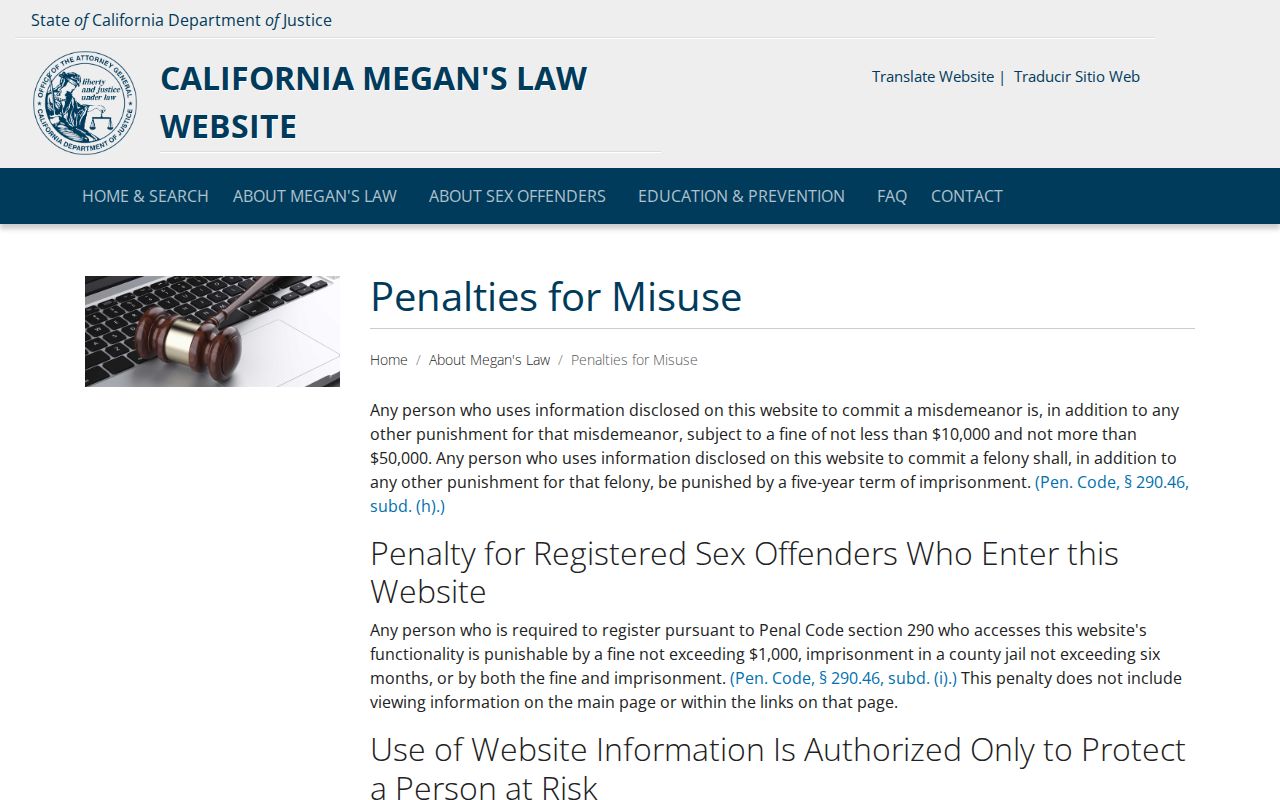
The warning applies to each Yolo County result, whether the profile shows a full address or only a broad area.
Misuse can be a crime: Penal Code section 290.46 allows criminal charges, civil liability, and added penalties for harassment or crimes committed with registry information. A registered person who accesses search functions may face up to a $1,000 fine and six months in jail. A misdemeanor committed through disclosed data can add a $10,000 to $50,000 fine, while a felony can add five years.